
Battery storage for edge, colocation and small-to-mid data centres.
Four applications, in the order they usually decide the project. The equipment on this site reaches 1.2 MW and 2.8 MWh per multi-AC cluster. Requirements above that range are quoted on enquiry through a separate supply path.
- Edge
- Colocation
- Small-to-mid facilities
Backup duration
One TIANWU unit holds 233 kWh and discharges at up to 100 kW. Duration is energy divided by load, so the same cabinet runs 2.3 hours at full rated power and 4.7 hours at half of it. Figures below are per cluster, before derating for depth of discharge and inverter losses.
| Cluster | Energy | At full rated power | At half rated power |
|---|---|---|---|
| 1 unit | 233 kWh | 100 kW → 2.3 hrs | 50 kW → 4.7 hrs |
| 3 units | 699 kWh | 300 kW → 2.3 hrs | 150 kW → 4.7 hrs |
| 6 units | 1.4 MWh | 600 kW → 2.3 hrs | 300 kW → 4.7 hrs |
| 12 units | 2.8 MWh | 1.2 MW → 2.3 hrs | 600 kW → 4.7 hrs |
Cluster sizing works back from two numbers: critical load, and the duration it has to cover.
Arbitrage and peak shaving
Charging happens off-peak and discharge into peak. Training and inference loads swing harder than legacy compute. Those swings breach connection limits and reset demand charges. Storage absorbs them within an existing connection.
FCAS revenue requires an aggregator relationship and market registration, and it moves with market conditions. It is modelled per site against your own load profile, with the assumptions stated.
Diesel displacement
A generator carries ownership, fuel, testing and maintenance cost, and earns nothing between outages. A battery covers the common outage cases and trades on the remaining days. Secondary diesel costs include emissions and air-quality permitting, noise limits, fuel storage, EPA obligations, and planning constraints on metro sites.
A battery holds finite energy; a generator runs as long as fuel keeps arriving. Long outages at megawatt scale remain genset territory on capex alone. The realistic outcome is to displace or downsize the diesel fleet rather than remove it: storage takes the short and medium outages, which is most of them, and a smaller generator stays for the rare long one. WHES documents an off-grid-with-generator configuration, so that pairing is a supported architecture.
Bridging power
Connection waits in the major Australian hubs now run past four years. On-site storage energises part of the floor during that wait.
Sizing is set against the load to be energised first, not the finished facility.
Cabinet format, not a containerised build.
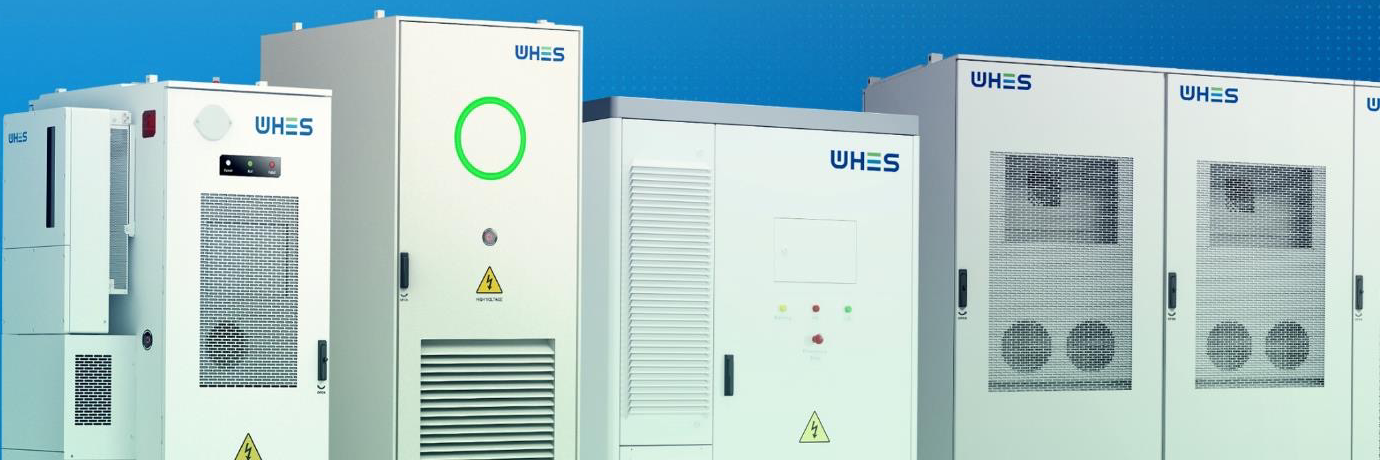
Each unit measures 1400 × 1350 × 2100 mm at roughly 2,700 kg, IP55 rated, under 65 dB. Capacity is added one cabinet at a time.
Ride-through and power conditioning are a separate function. EPS transfer is under 10 ms, which is not equivalent to a double-conversion, zero-transfer UPS. Storage sits behind the UPS, extending runtime rather than replacing conditioning.
The WHES range tops out at 1.2 MW and 2.8 MWh per multi-AC cluster, which covers edge, colocation and small-to-mid facilities. Larger requirements are quoted on enquiry and scoped against Australian approvals.
Utility-scale — on enquiry
Storage above the C&I range comes through a separate supply path: a utility-scale CATL integrator rather than WHES. Capacities, specifications and certification are not published for it, since scope depends on the requirement and on Australian approvals. Facilities above the range shown here start with a technical enquiry.
Power planning
Facility size, required duration, and the status of the connection application.